How much does an automated warehouse picking system cost?
The investment in a GTP system depends on the number of workstations required and the desired throughput (picks per hour). Because SAVOYE solutions are modular, you can begin with a setup that matches your current volume and add more stations as your business grows. While the initial CAPEX is higher than manual shelving, the reduction in long-term operational costs makes it a highly strategic investment for Middle Eastern enterprises.
What is the ROI of goods-to-person picking?
The Return on Investment (ROI) for a SAVOYE GTP system is typically achieved within 2 to 3 years. This is driven by:
- 4x productivity increase: one operator at a GTP station can do the work of four manual pickers.
- Space savings: high-density storage coupled with GTP stations reduces the required warehouse footprint by up to 50-80%.
- Error elimination:picking accuracy reaches near 100%, drastically reducing the costs of returns and customer dissatisfaction.
How long does it take to implement an automated warehouse picking system?
A standard implementation of SAVOYE pick stations, including integration with the storage medium and software, usually takes between 8 to 12 months. Our team handles everything from ergonomic station design to the final “go-live,” ensuring your staff is fully trained on the intuitive interface.
Can goods-to-person picking integrate with WMS or WCS?
Absolutely. For a GTP system to function, it must be perfectly synchronized with the “brain” of the warehouse. SAVOYE pick stations are designed to integrate natively with our ODATiO WMS and WCS, providing real-time data on picking rates, inventory levels, and order status. They can also be interfaced with existing third-party ERP systems via robust APIs.
Is goods-to-person picking suitable for high-volume operations?
It is the gold standard for high-volume environments. Whether you are managing thousands of SKUs for an e-commerce platform or high-cadence spare parts distribution, SAVOYE GTP pick stations are built for intensive use. They are specifically engineered to handle peak periods (like Ramadan or Black Friday) by maintaining a consistent, high-speed flow that manual picking simply cannot match.
What is the difference between goods-to-person picking and pick-to-light? (lien interne vers la page pick-to-light / put-to-light)
Both goods-to-person picking and pick-to-light are proven methods for improving accuracy and throughput in a warehouse, but they operate on fundamentally different principles and suit different operational profiles.
With pick-to-light, the products stay in fixed storage locations and the operator moves through the warehouse. Light displays mounted on shelving units guide the picker to the right location and indicate the quantity to take. The operator walks to the goods. This approach delivers excellent speed and accuracy in zone picking environments, particularly for fast-moving SKUs in a well-organised warehouse. It requires a relatively modest investment and can be deployed quickly.
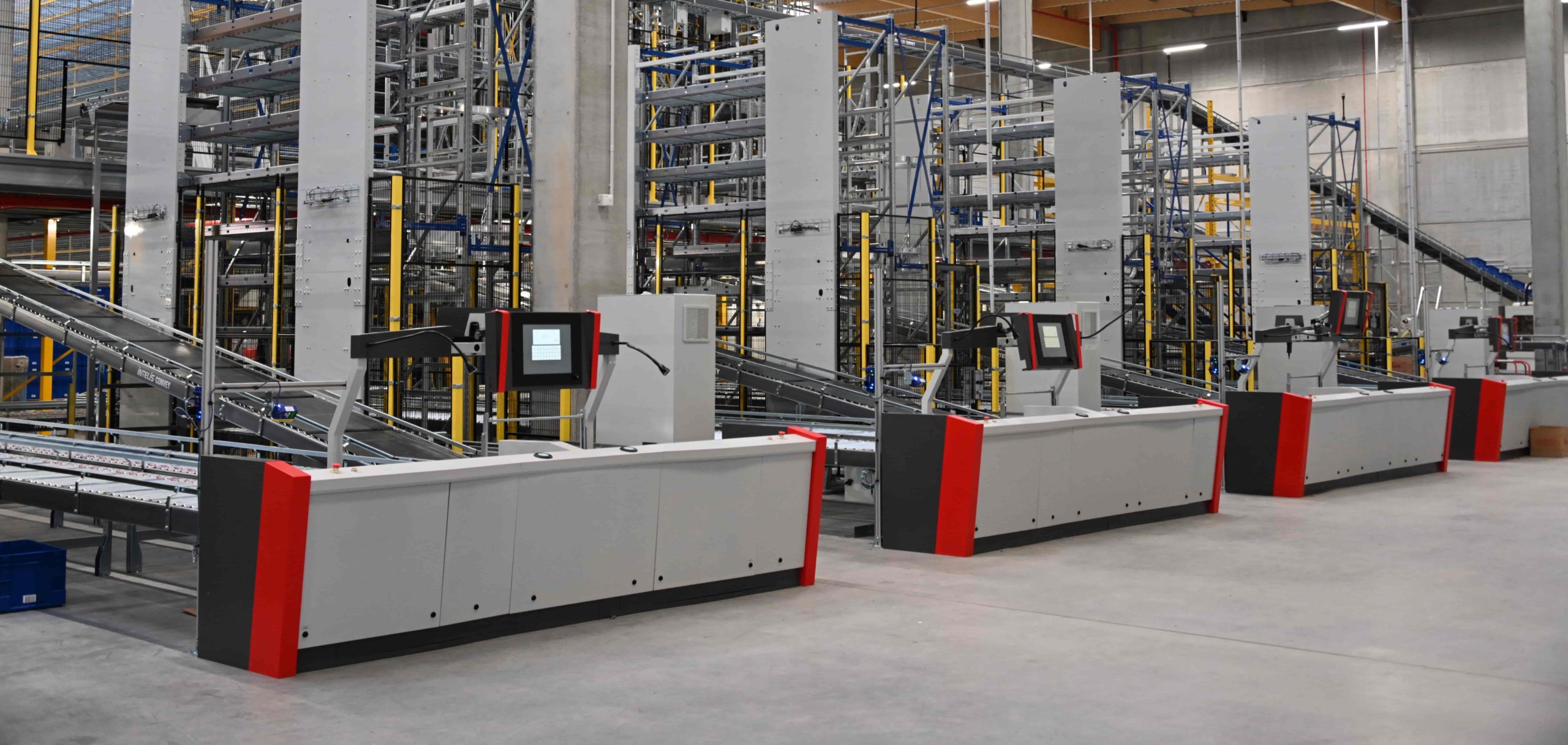
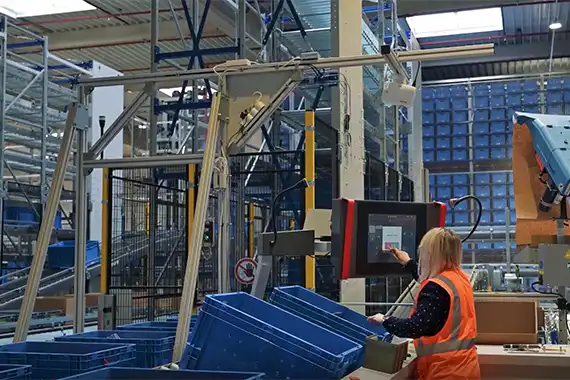
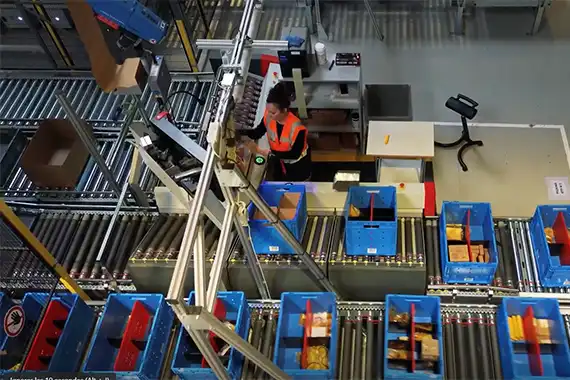
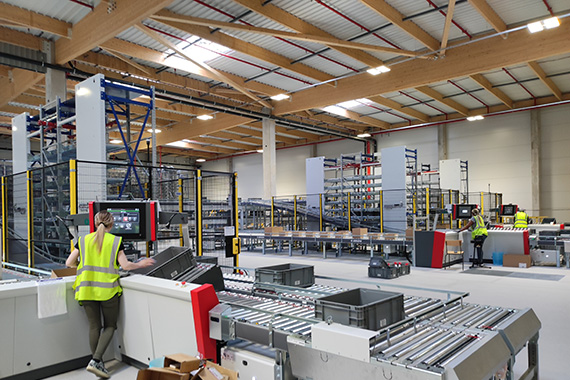
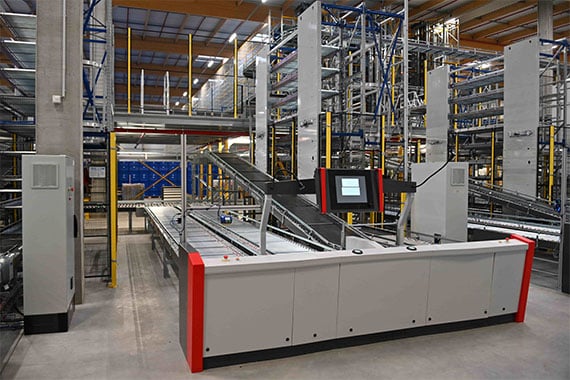
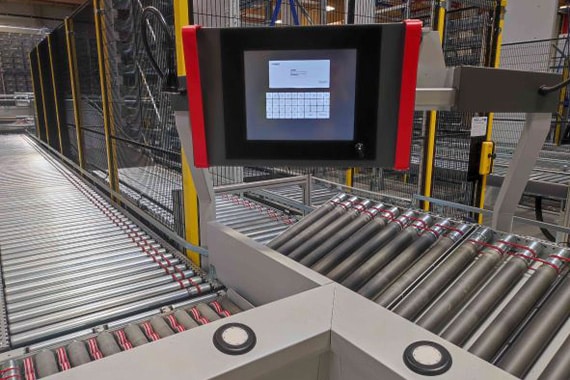
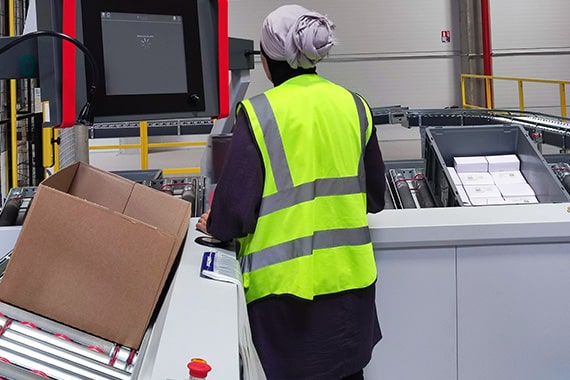
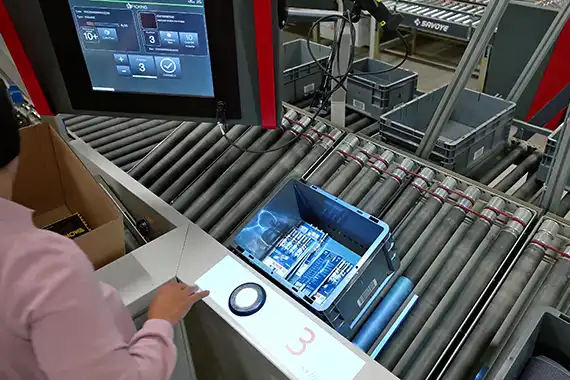
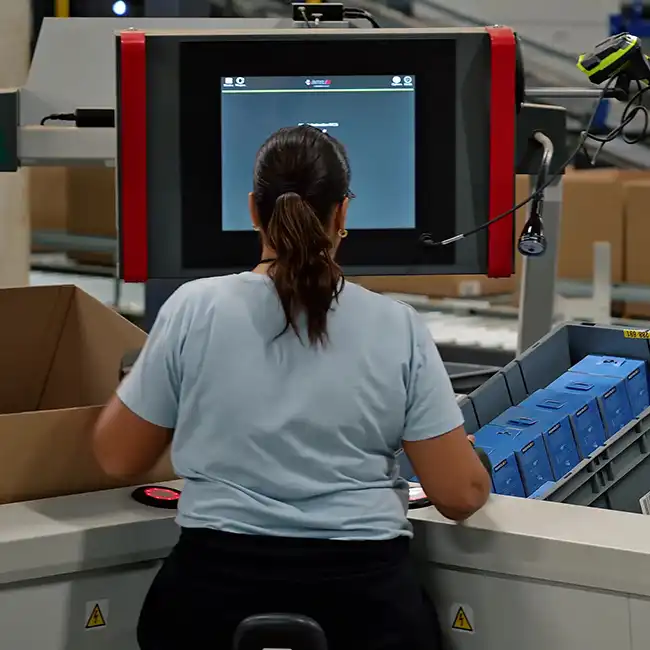
With goods-to-person picking, the logic is reversed: the operator stays at a fixed workstation, and an automated system (such as the SAVOYE X-PTS shuttle or HAIPICK Climb AMR robots) brings the storage bins to the picker. There is no walking, no searching, and no physical strain from navigating a warehouse. The operator focuses entirely on the picking task, guided by the system’s visual interface.
The practical differences are significant:
Pick-to-light is ideal when you need to improve the speed and accuracy of operators who are already mobile within a defined zone. It is a strong fit for batch picking, fast-mover areas, and operations where investment needs to be kept low to moderate.
Goods-to-person picking delivers superior throughput and ergonomics for high-volume operations where productivity per operator and working conditions are strategic priorities. A single operator at a SAVOYE GTP station can process between 300 and 700 order lines per hour, a performance level that pick-to-light alone cannot match at scale.
In practice, both solutions can coexist in the same warehouse and complement each other. SAVOYE’s design teams work with you to determine which technology, or which combination, fits your specific SKU profile, volume, and operational goals.
Discover SAVOYE’s pick-to-light and put-to-light solutions
How do you choose the right automated warehouse picking system?
There is no single automated warehouse picking system that fits every operation, and the right choice depends on a careful assessment of your current situation and your ambitions. At SAVOYE, we guide our clients through this decision with a structured approach built on four key questions :
- What is your order volume and growth trajectory?
If you are processing a few hundred orders per day with stable volumes, a pick-to-light or voice picking solution may be entirely sufficient. If you are handling thousands of order lines per day, or if you expect significant growth in the next three to five years, goods-to-person picking offers the throughput and scalability to match your ambition. SAVOYE’s GTP systems are modular: you start with the capacity you need today and expand as your business grows.
- What does your SKU profile look like?
The number of references you manage, the frequency at which they are picked, and the size and weight of your products all influence which system will perform best. Fast-moving, small-to-medium items in bins are ideally suited to GTP picking with shuttle systems. Mixed-profile operations may benefit from a combination of GTP for fast movers and pick-to-light or AMR-assisted picking for slower or bulkier references.
- What are your operational constraints?
Building height, floor space, existing infrastructure, and whether your warehouse is a greenfield or a retrofit all matter. SAVOYE’s solutions are engineered to integrate into a wide range of environments, including existing buildings, with minimal disruption to ongoing operations during installation.
- What are your operator wellbeing priorities?
In markets where workforce retention and working conditions are increasingly important, the ergonomic advantages of goods-to-person picking carry real strategic weight. An operator who does not walk kilometres every shift, who works at a station designed around correct posture, and who has a clear and simple task to perform is a more engaged, more productive, and more loyal team member
The best way to make the right choice is to work with a partner who can model your operation, simulate throughput scenarios, and build a business case grounded in your real data. That is exactly what SAVOYE’s design and consulting teams do, from the first conversation to the day your system goes live and beyond.