How do warehouse mobile robots work?
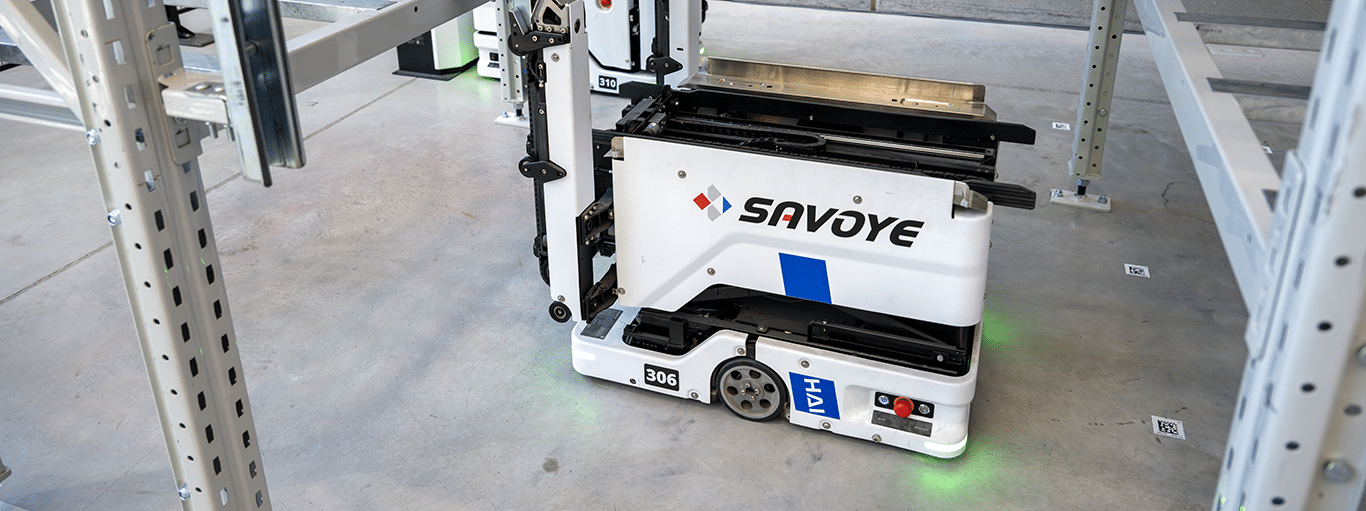
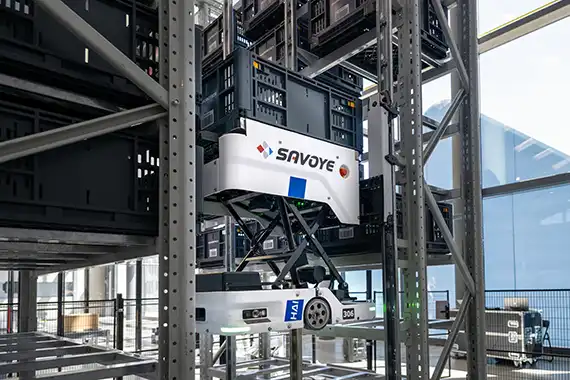
SAVOYE mobile robots use LiDAR and SLAM (Simultaneous Localization and Mapping) technology to create a digital map of your warehouse. When the WMS triggers an order, the robot calculates the most efficient path, uses its telescopic fork to pick the correct container, and autonomously navigates to the delivery point, constantly updating its route to avoid traffic or obstacles.
How much does an autonomous mobile robot system cost?
The cost of a HAIPICK system is highly modular. Unlike fixed automation, you don’t need a massive upfront investment for the entire warehouse. You can start with a small fleet of robots and a few aisles of shelving. This “Pay-as-you-grow” model makes the initial CAPEX much more manageable for Middle Eastern SMEs and large enterprises alike, often resulting in a faster ROI than traditional automation.
Can mobile robots integrate with WMS and WCS?
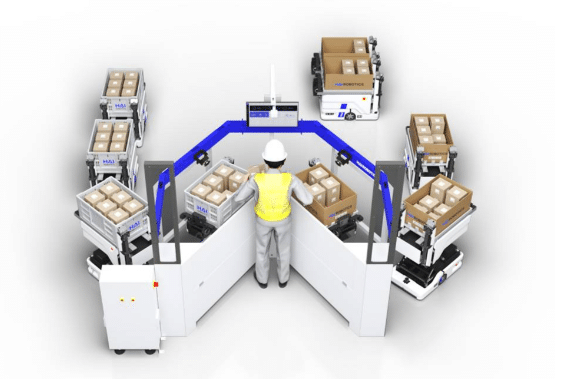
Yes. For the HAIPICK system to be effective, it must be perfectly synchronized with your software stack. SAVOYE ensures seamless integration with your existing WMS (Warehouse Management System) and WCS (Warehouse Control System). This allows for real-time inventory updates, precise task allocation, and total visibility over your robotic fleet through a single dashboard.
What is the difference between an AMR and an AGV?
Autonomous mobile robots (AMRs) and automated guided vehicles (AGVs) are both used to automate the movement of goods within a warehouse, but they differ significantly in how they navigate, how they adapt, and how they fit into a modern operation.
An AGV follows a fixed path defined by physical infrastructure embedded in the floor: wires, magnetic strips, or reflective markers. Every route is predetermined. If something blocks the path, the AGV stops. If you want to change a route, you need to physically modify the floor or reinstall guidance systems, which means downtime, cost, and disruption.
An AMR operates on a completely different principle. It builds a map of its environment using onboard sensors and navigates dynamically, choosing the optimal path in real time based on current conditions. If an obstacle appears, it reroutes autonomously. If your warehouse layout changes, you update the map in software, not in concrete.
For operations in the Middle East, where warehouses are often in leased buildings, business models are evolving rapidly, and the ability to adapt matters enormously, this distinction is decisive. AMRs give you the agility to respond to change without committing to infrastructure that is expensive to modify and impossible to move.
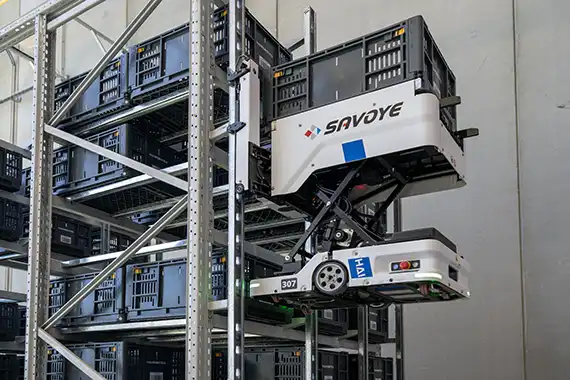
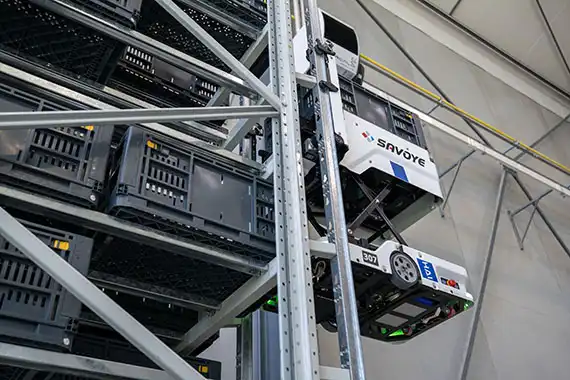
HAIPICK Climb AMRs go further still: their ability to climb racking structures to retrieve bins at height means they combine the flexibility of autonomous navigation with the storage density that was previously only achievable through fixed, heavy-infrastructure shuttle systems. It is the best of both worlds, delivered in a system that can be operational in weeks rather than months.
What is the difference between an autonomous mobile robot and a shuttle ASRS?
Both autonomous mobile robots and shuttle ASRS (Automated Storage and Retrieval Systems) are designed to automate goods movement in a warehouse, and both can support goods-to-person picking workflows. But they represent very different choices in terms of infrastructure commitment, flexibility, and operational profile.
A shuttle ASRS is a high-performance, fixed system. Shuttles run on rails integrated into a dedicated racking structure, and the entire layout is designed and built as a single engineered installation. Once in place, a shuttle system delivers exceptional throughput and storage density, and it is an excellent choice for operations with stable, high volumes and a long-term commitment to a specific facility.
An autonomous mobile robot system, by contrast, requires no rails and no permanent floor modification. The racking structure used by HAIPICK Climb is modular and can be assembled, extended, or reconfigured far more easily than the fixed infrastructure of a traditional shuttle ASRS. If your volumes grow, you add robots and racking. If your business moves to a new facility, the system moves with you.
The choice between the two often comes down to where your business is today and where it is going. If you are operating a large, stable, high-volume facility with a long-term lease and a clear capacity plan, a shuttle ASRS may be the right anchor technology. If your operation is growing, your facility footprint is not yet fixed, or you need to be able to adapt your warehouse configuration as your business evolves, HAIPICK Climb AMRs offer a level of agility that fixed shuttle systems simply cannot match.
At SAVOYE, we offer both technologies, as well as hybrid architectures that combine AMRs and shuttle systems within the same warehouse. Our design teams model your specific operation to determine which approach, or which combination, delivers the strongest return on investment for your situation.
Are autonomous mobile robots suitable for high-density warehouses?
This is one of the most common questions logistics and supply chain directors ask when evaluating AMR technology, and the answer has changed significantly with the arrival of rack-climbing AMRs such as HAIPICK Climb.
Traditional floor-travelling AMRs are primarily horizontal systems. They move goods across the floor efficiently, but they do not exploit the vertical space of a warehouse, which limits their storage density compared to shuttle-based or mini-load systems.
HAIPICK Climb was designed specifically to address this limitation. By combining autonomous horizontal navigation with the ability to climb directly onto racking structures, these robots access bins stored at heights of up to 12 metres. Aisle width is reduced to 900 mm, no cross-aisles are required, and storage is accessible from both faces of the racking. The result is a storage density that competes directly with traditional high-density fixed systems, delivered within a flexible, modular architecture.
For warehouses in the UAE and GCC where real estate costs are significant and maximising every square metre of floor space has a direct impact on operational economics, this matters enormously. HAIPICK Climb allows you to achieve the density you need without locking yourself into infrastructure that cannot evolve with your business.
So yes: with the right AMR technology, high-density storage and operational flexibility are no longer a trade-off. SAVOYE has engineered HAIPICK Climb precisely to give you both.